
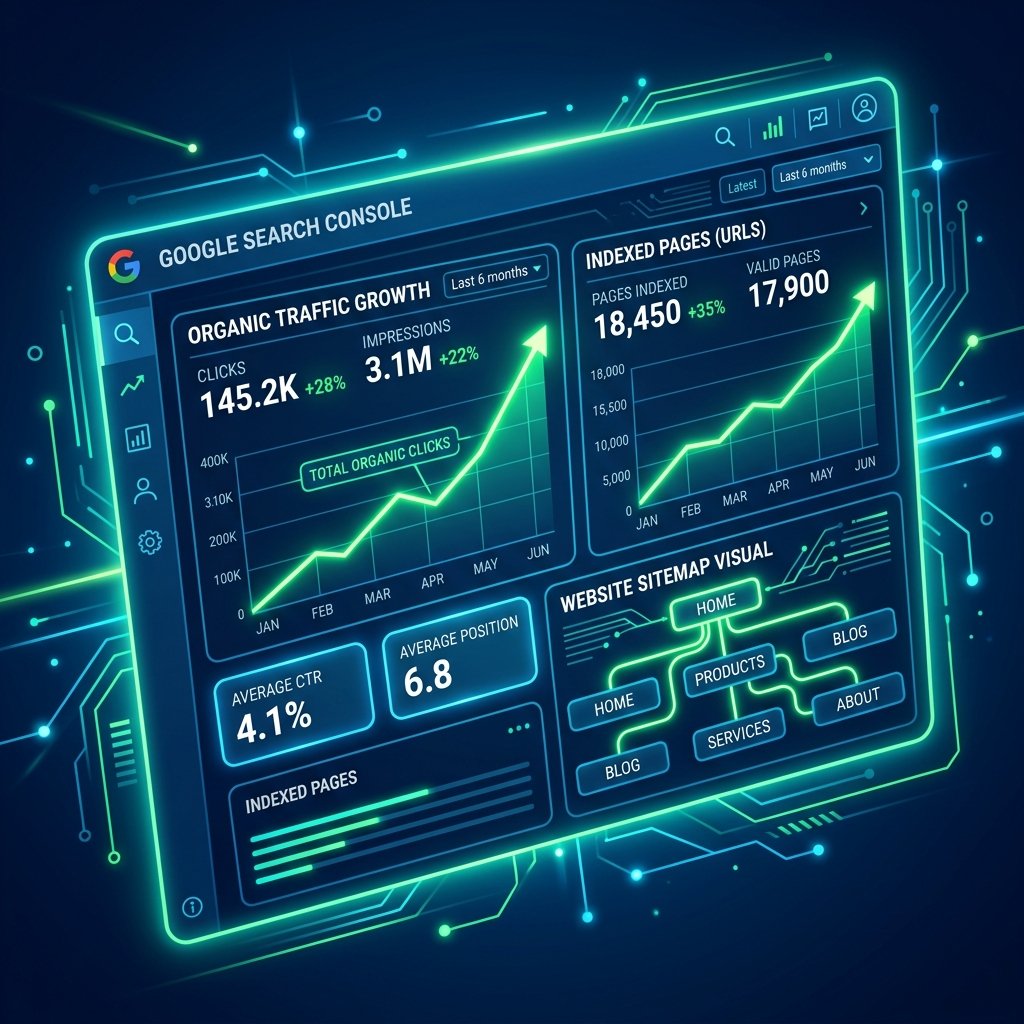
Launching a web app or developer blog in 2026 comes with a new set of silent challenges. While deployment is faster than ever thanks to modern static edge hosting, search engine discoverability has slowed down. Googlebot's automated crawling budgets are highly optimized, which means new, low-authority domains are often left in the "discovered - currently not indexed" status for weeks.
When we launched ByteSprint, we faced the exact same problem. We had premium designs, high-performance clean HTML/CSS, and original deep dives, but zero Google impressions. To get out of the sandbox, we had to systematically address indexation APIs, sitemaps, domain authority, and organic referral traffic. Here is our technical blueprint to get indexed in under 48 hours and attract high-intent visitors.
1. Setting Up Google Search Console for Success
The first and most critical step is claiming ownership of your domain in the Google Search Console (GSC). Do not rely on automated discovery. By setting up a Domain Property (DNS TXT record verification), you unlock the ability to submit XML sitemaps directly and request manual inspections.
Once verified, submit your sitemap.xml immediately. Ensure your sitemap uses absolute URLs, has correct <lastmod> tags, and lists only pages that return a 200 OK status code. Pages with canonical tags pointing to other URLs should never be listed in the sitemap, as this confuses Google's crawler budget.
2. Overcoming the Domain Sandbox Effect
For new domains, Google applies a silent validation period—often called the "sandbox effect." Google wants to ensure your site is not a temporary spam domain created by automated tools. To speed up this trust building phase:
- Complete Legal Compliance: Have easily readable links to your Privacy Policy and Terms of Conditions. Google's review algorithm explicitly looks for these pages to verify site legitimacy.
- Consistent E-E-A-T Elements: Build a dedicated "About Us" page detailing the real writers behind the site. If your articles are signed by names not found in the editorial profiles, manual reviewers may flag the content.
- Avoid Empty Layout Placeholders: Ensure your social links, navigation menus, and form targets are active. Avoid dead links (like raw
#symbols in hrefs) or incomplete templates.
3. Automating Indexation Pings with Python
If you publish new guides and wait for the crawler, it can take days. Instead, developers can use Google's official ping service or write scripts to automate indexing checks. Below is a Python script that parses your site's local sitemap and uses Google's public update endpoints to request immediate crawler visits.
import urllib.request
import urllib.parse
import xml.etree.ElementTree as ET

def ping_search_engines(sitemap_url):
    print(f"Parsing sitemap: {sitemap_url}...")
    try:
        # Fetch and parse sitemap XML
        req = urllib.request.Request(
            sitemap_url,
            headers={'User-Agent': 'ByteSprint-Indexer-Bot/1.0'}
        )
        with urllib.request.urlopen(req) as response:
            xml_data = response.read()

        # Parse XML namespaces
        root = ET.fromstring(xml_data)
        namespace = {'ns': 'http://www.sitemaps.org/schemas/sitemap/0.9'}
        urls = [url_elem.find('ns:loc', namespace).text for url_elem in root.findall('ns:url', namespace)]

        print(f"Found {len(urls)} URLs. Initiating crawler pings...")

        for url in urls:
            # Google ping endpoint (standard web update notification)
            encoded_url = urllib.parse.quote_plus(url)
            ping_url = f"https://www.google.com/ping?sitemap={encoded_url}"

            ping_req = urllib.request.Request(
                ping_url,
                headers={'User-Agent': 'Mozilla/5.0'}
            )
            try:
                with urllib.request.urlopen(ping_req) as ping_res:
                    if ping_res.status == 200:
                        print(f"[+] Successfully pinged Google for: {url}")
            except Exception as e:
                print(f"[-] Failed to ping: {url}. Reason: {e}")

    except Exception as e:
        print(f"Error parsing sitemap: {e}")

# Example: ping_search_engines("https://bytesprint.dev/sitemap.xml")
4. Driving Organic Referral Traffic
Search engines rank pages higher when they see real user engagement and low bounce rates. High-intent traffic is the best signal of content authority. To get your first 100 targeted visitors, don't spam. Share your deep dives on platforms where developers actively search for answers:
- Reddit (Developer Communities): Share technical blueprints in subreddits like
r/webdev,r/frontend, orr/LocalLLaMA. Focus on the code snippets and avoid promotional text. Let the quality of the technical article speak for itself. - Hacker News: Submit opinionated or high-performance case studies (such as migrants from CSS frameworks or hardware optimizations) with descriptive, objective titles.
- Pinterest & Developer Portals: Create high-fidelity visual cards showing design benchmarks and code snippets to catch visual searchers.
By combining technical search configuration, automated ping notifications, and transparent E-E-A-T credentials, you can accelerate your website's organic visibility, bypass the initial sandbox, and build a lasting audience of developer readers.